You’ve got concrete coming. Now you need to figure out how to get it from the truck to the pour site. Two options sit in front of you: hire a concrete pump or grab some wheelbarrows and rally a crew.
Concrete pumping has become the go-to method for most professionals, but wheelbarrowing still holds its place for certain jobs. Both methods move concrete. However, they differ significantly in terms of speed, cost, effort, and results. The right choice depends on your pour size, site access, timeline, and budget.
Quick Answer: Which Should You Choose?
Here’s a cheat sheet for common scenarios:
- Small patio near the truck: Wheelbarrow
- Long back garden with no truck access: Pump
- Upper floor slab: Pump
- Tight deadline: Pump
- Limited budget, tiny pour: Wheelbarrow
- Muddy or sloped ground: Pump
Talk to your concrete supplier early. They can advise on volume estimates and whether your site suits pumping or wheelbarrowing.
What Is Concrete Pumping?
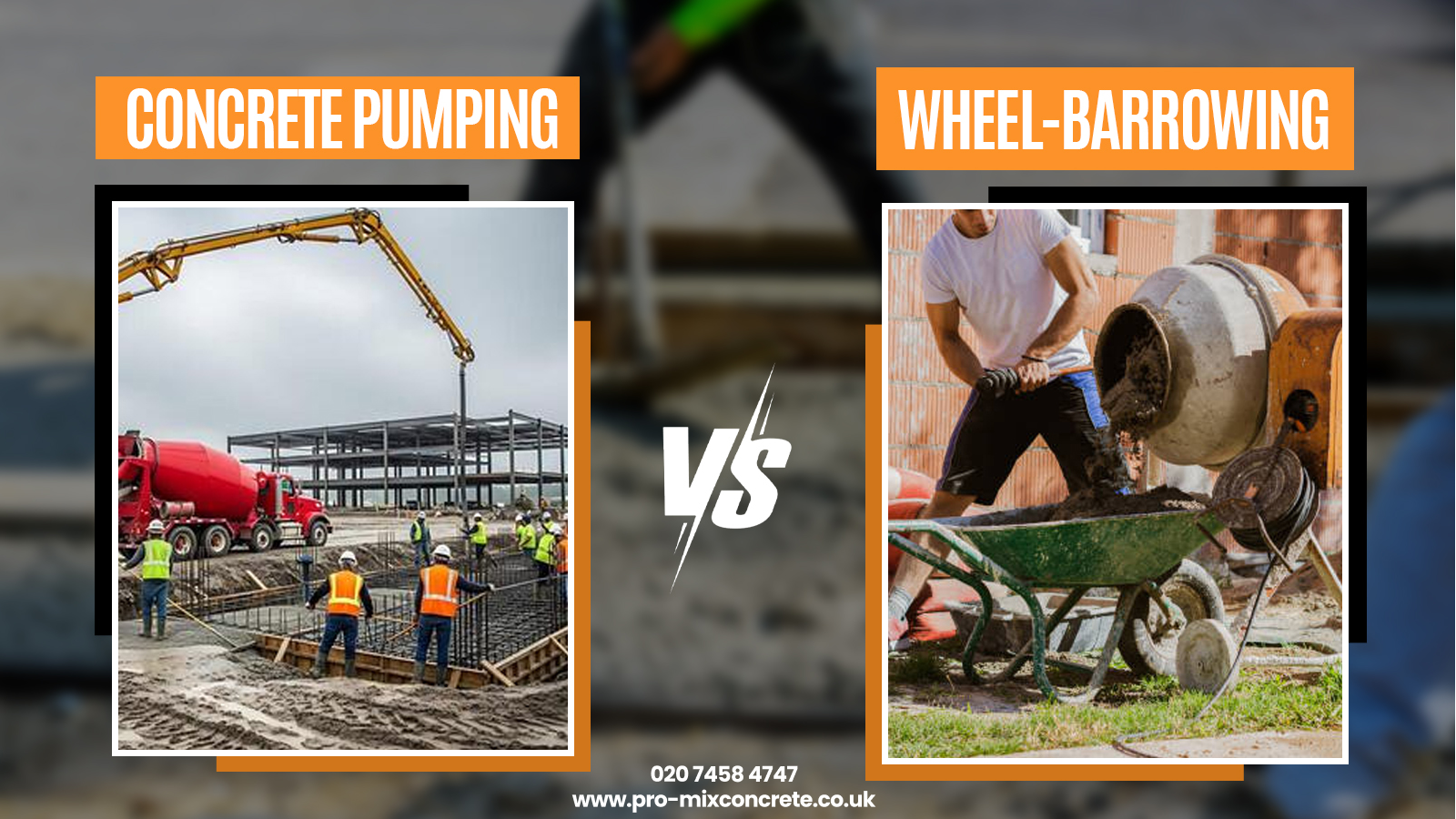
Concrete pumping is a method of transferring wet concrete from the delivery truck to the pour site using a pump and flexible hose or boom arm.
How Concrete Pumps Work?
Two main types exist:
- Line pumps use a trailer-mounted pump to push concrete through steel or rubber hoses. The hoses can run across the ground, through buildings, or over walls. Line pumps are best for residential and smaller commercial projects.
- Boom pumps are truck-mounted with a remote-controlled arm that unfolds and extends. The boom can reach over houses, past obstacles, and onto upper floors without moving the truck. Boom pumps are designed for large pours and high-rise construction.
Both methods deliver concrete exactly where you need it without moving the truck closer.
Best Situations for Pumping
Concrete pumping is ideal when:
- The pour is medium to large in volume
- Deadlines are tight, and speed matters
- The pour site is far from truck access
- You need to reach the upper floors or the basements
- Ground conditions are muddy, sloped, or uneven
- Obstacles block direct wheelbarrow paths
What Is Wheelbarrowing?
Wheelbarrowing is the traditional method of moving concrete manually from the delivery truck to the pour area using wheelbarrows.
How Wheelbarrowing Works?
A team loads wheelbarrows directly from the truck’s chute. Workers push the loaded barrows to the pour site, dump the concrete, and return for another load. This cycle repeats until the pour is complete.
A typical setup includes the truck driver managing the chute plus two to four labourers running barrows. Basic tools include sturdy wheelbarrows, shovels, rakes, and rubber boots.
Best Situations for Wheelbarrows
Wheelbarrows are suitable when:
- The pour is small, such as post holes or tiny pads
- The truck can park very close to the pour area
- Ground is flat, firm, and obstacle-free
- Timing is flexible, and delays are acceptable
- Plenty of labour is available and affordable
Head to Head: Pumping vs Wheelbarrowing
Here’s how pumping and wheelbarrowing compare when it comes to the factors that actually matter on site.
Key Differences at a Glance
Factor | Concrete Pumping | Wheelbarrowing |
Speed | Fast, continuous pour | Slow, stop-start cycles |
Labour needed | 1–2 operators | 3–5 labourers minimum |
Site access | Reaches awkward spots | Needs a clear, flat path |
Finish quality | Smoother, more consistent | Risk of cold joints |
Typical cost | Higher upfront | Lower if labour is cheap |
Site mess | Minimal spillage | More spillage and tracking |
Clear Wins:
Pumping takes speed, access, and finish quality. Wheelbarrowing can win on upfront cost for very small jobs.
Time, Labour, and Safety
A concrete pump delivers 30 to 90 cubic metres per hour, depending on the setup. A team of four labourers with wheelbarrows moves roughly 2 to 4 cubic metres per hour on a good run.
For a typical 10 cubic metre slab, pumping finishes in under an hour. Wheelbarrowing the same volume takes three to five hours with a solid crew.
Safety improves with pumping. Fewer manual trips mean less strain on backs and knees. Workers avoid pushing heavy loads across uneven or slippery ground, fatigue drops, and so do injury risks.
Quality and Access
Continuous pouring is critical for concrete strength. Pumping ensures a steady flow that bonds properly and cures evenly, while wheelbarrowing can create stop-start gaps that form cold joints and weak spots.
Access is where pumping shines brightest. Hoses snake through narrow passages, over garden walls, and into tight basements. Boom arms swing concrete onto upper floors without scaffolding or bucket lifts. Wheelbarrows need a clear, flat, firm path from the truck to the pour site. One muddy patch or flight of stairs changes everything.
How to Decide on Your Project?
Ask yourself these five questions:
- How big is the pour? Over 2 cubic metres usually favours pumping.
- How far is the pour site from truck access? Over 20 metres tips toward pumping.
- What’s the ground like? Mud, slopes, or obstacles make wheelbarrows risky.
- How many helpers do you have? Fewer than three means pumping saves time and strain.
- How tight is your schedule? Tight deadlines almost always call for pumping.
If most answers point toward pumping, book a pump. If the job is tiny, close, flat, and flexible on timing, wheelbarrows can work. A reliable concrete supplier can help you calculate the right volume and recommend the best delivery method based on your site conditions.
Bottom Line
Concrete pumping saves time, reduces labour, improves finish quality, and reaches places wheelbarrows simply cannot. It costs more upfront but often pays for itself through faster pours and fewer workers.
Wheelbarrowing still has its place for very small jobs with easy access, flexible timelines, and available labour. But for most residential and commercial pours, pumping is the smarter choice.
Need a reliable partner for your next pour?
Pro-Mix Concrete delivers quality concrete and concrete pumping services across the UK with flexible scheduling and expert advice. You get fast quotes, on-time delivery, and concrete mixed to the strength and type you require.
Get in touch and make your next project the easiest one yet.
Frequently Asked Questions
Is concrete pumping really worth it for a small job?
It depends on access and distance. For pours under 2 cubic metres with easy truck access, wheelbarrows work fine. But if the site is awkward, pumping saves time and hassle even on small jobs.
How far can a concrete pump reach compared to wheelbarrows?
Line pumps push concrete up to 150 metres through hoses. Boom pumps extend 20 to 60 metres vertically and horizontally. Wheelbarrows are limited to how far workers can physically push them.
Is it cheaper to hire a concrete pump or use wheelbarrows and extra labour?
Wheelbarrowing costs less upfront for tiny pours. But labour adds up fast on bigger jobs. Pumping often proves cheaper when you factor in time saved and fewer workers needed.
When should I choose wheelbarrowing instead of concrete pumping?
Choose wheelbarrows for very small pours like post holes or pads under 2 cubic metres. The truck must park close, the ground must be flat, and you need enough helpers to keep pace.
Does pumping concrete give a better finish than wheelbarrowing it?
Yes, continuous pumping creates consistent pours without cold joints. Wheelbarrowing causes stop-start gaps that can weaken the slab and affect surface finish quality.

- Dennis Broderick
- Dennis Broderick is the founder and owner of Pro-Mix Concrete Company, a trusted name in ready-mix concrete solutions across the UK. With over 20 years of hands-on experience in the construction and concrete industry, Dennis brings unmatched expertise, practical insights, and a commitment to quality on every project - from residential driveways to large-scale commercial developments.
 BlogOctober 16, 2026What Strength Concrete Is Needed: Understanding PSI Ratings in Concrete
 BlogOctober 14, 2026How Much Does a Concrete Foundation Cost in the UK?
 BlogOctober 1, 2026An Overview of How Ready-Mix Concrete Works
 BlogSeptember 30, 2026Different Types of Concrete Strengths and Their Uses