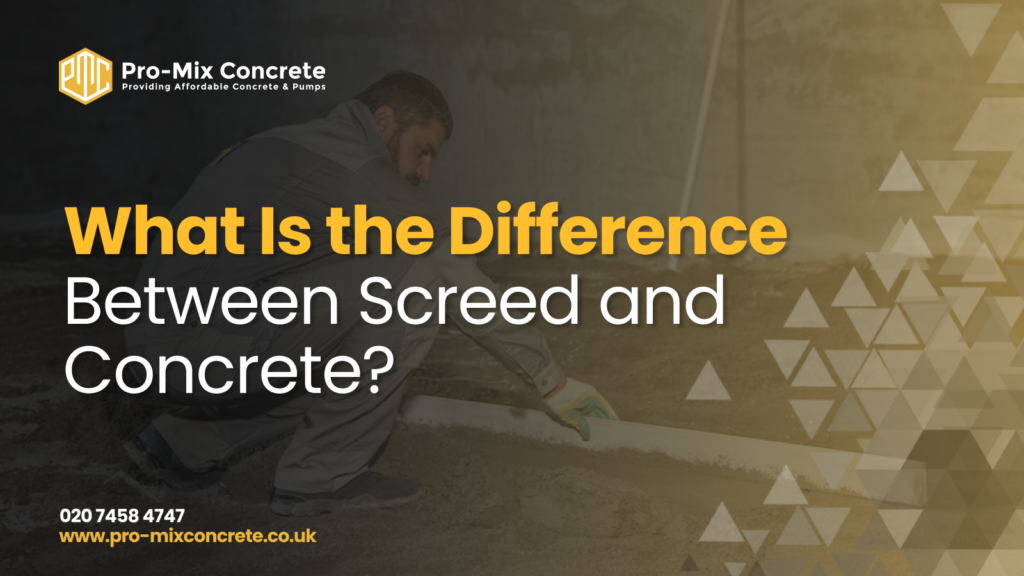
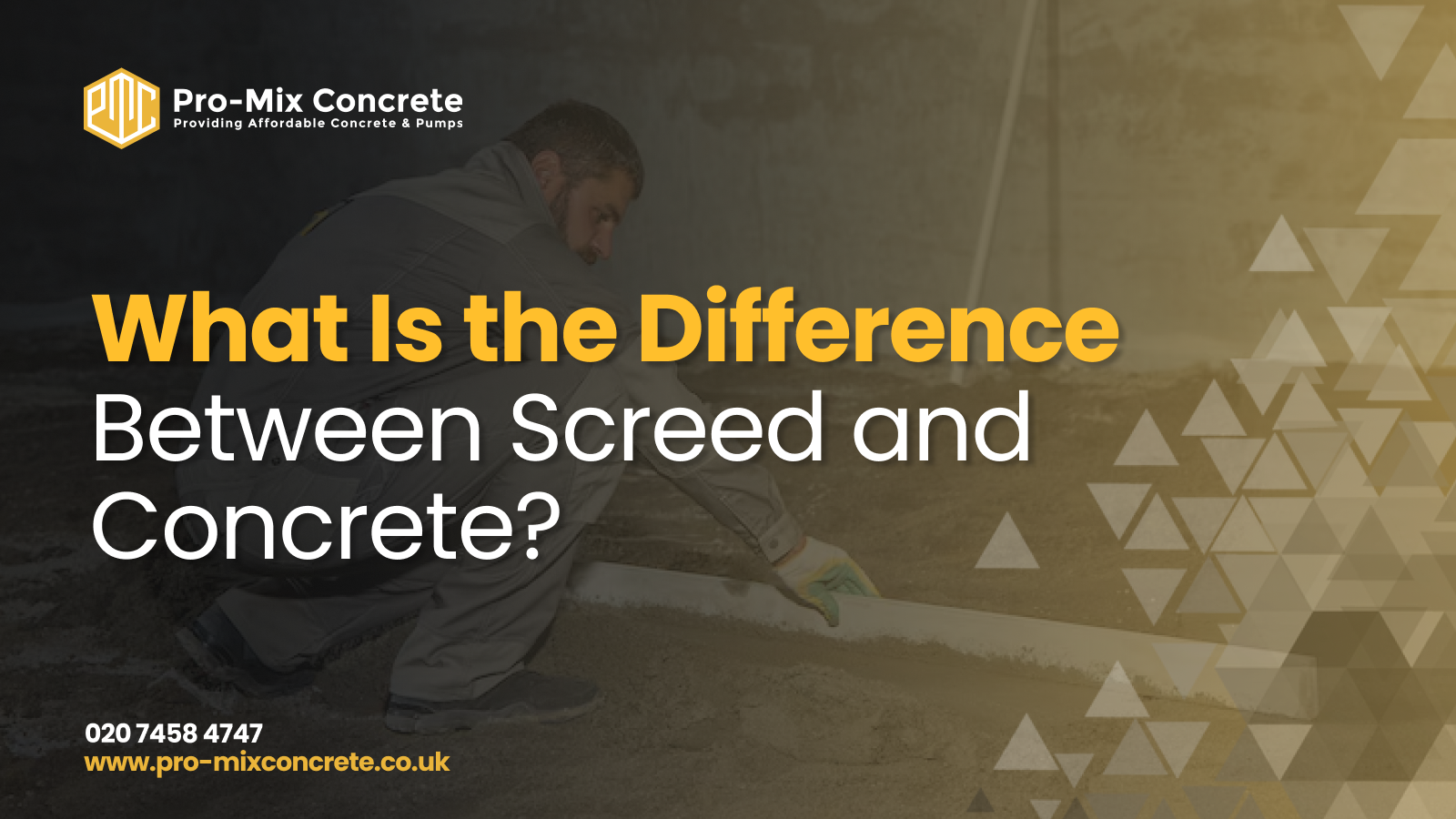
Ask three tradespeople whether your new floor needs screed or concrete, and you can walk away with three different answers. The two words get used as if they mean the same thing, which is understandable, because both start life as cement, aggregate and water mixed into a grey, pourable material. Look a little closer, though, and they turn out to be built for opposite ends of the same job. Concrete is the muscle underneath, the structural layer that carries the weight of a building, a driveway or a slab. Screed is the fine layer that goes over it, smoothing everything into a flat, level surface ready for tiles, wood or vinyl.
Getting the two confused is not a small mistake. Pour structural concrete where a smooth screed was needed, and your flooring sits on an uneven, coarse base. Lay a thin screed where load-bearing concrete belonged, and the surface cracks the first time real weight lands on it.
In Short:
Concrete is the strong, structural base. Screed is the smooth, level top layer. Most floors need both, one poured over the other.
What Is Concrete?
Concrete is the structural backbone of almost every build. Cement, water, and a blend of coarse and fine aggregate combine into a material with the compressive strength to carry heavy, sustained loads. The coarse stone in the mix is what gives it that strength, and it is why concrete ends up wherever a structure has to hold, from footings and foundations to ground slabs and driveways.
Pro-Mix Concrete supplies concrete across grades from C10 to C40, delivered ready-mixed concrete or batched fresh on site to the exact strength a job needs.
- Made with coarse aggregate up to 20mm for strength
- High compressive strength for load-bearing work
- Graded C10 to C40 concrete under BS 8500
- Used for foundations, slabs, driveways and footings
- Laid in thick structural sections
What Is Screed?
Screed does the finishing work concrete cannot. Laid as a thin layer over a structural base, it uses sharp sand in place of coarse stone, which makes it fine and workable enough to trowel perfectly flat. Screed is never meant to carry structural load. Its purpose is a smooth, level, sound surface that flooring can sit on, or a bed that encases underfloor heating pipes and spreads their warmth evenly into the room.
Think of screed as the layer between rough structural concrete and the finish you actually see and walk on.
- Made with fine sharp sand, no coarse stone
- Cement-to-sand ratio around 1:3 to 1:4.5
- Laid thin over a structural base
- Levels the floor for its final covering
- Wraps underfloor heating for even warmth
Key Differences Between Screed and Concrete
Both begin with cement, yet they part ways on almost everything that follows: the ingredients, the strength, the depth, how long each takes to dry, and what it costs. Here is each difference in full.
Composition and Aggregate
The stone in the mix is the difference everything else grows from. Concrete carries coarse aggregate, the gravel and crushed rock up to 20mm that lock together and give it strength. Screed leaves the stone out entirely and relies on fine sharp sand, usually no larger than around 4mm, for a smooth, even body. The Concrete Society describes aggregate as the major constituent of concrete by volume, split into coarse and fine grades. Take the coarse grade away, and the material stops being a load-bearer and becomes a leveller instead.
Strength and Load-Bearing Ability
Strength is the clearest line between the two, and it decides where each belongs:
- Concrete reaches high compressive strength, from around 20 N/mm² upward by grade, enough to carry buildings, vehicles and heavy point loads.
- Screed is mixed for a level, sound surface rather than structural strength, and it should never stand in for concrete on anything load-bearing.
Concrete carries the weight. Screed carries the finish. Swap those roles and one of them fails.
Texture and Appearance
Texture gives the game away before either has even cured. Concrete looks rugged, with stones visible through a coarse grey body. Screed looks and feels fine and uniform, closer to a thick mortar, because nothing larger than sharp sand goes into it. Run a hand across a finished slab of each, and your fingers tell you which is which.
Thickness and How Deep Each Is Laid
Depth follows directly from the job each one does. Concrete is placed in thick structural sections, typically 100mm or more, so it can spread and carry load across a foundation or slab. Screed sits far shallower on top. The recommended thickness for a bonded sand and cement screed is 25 to 40mm, while unbonded and floating screeds are laid slightly deeper over a membrane or insulation. The concrete builds the base, and the screed finishes it in a thin, level skin.
Worth Knowing:
Screed is only as sound as the base beneath it. A weak or uneven concrete slab will telegraph its faults straight up through a thin screed.
How Each Is Laid and Finished
The work on site looks nothing alike from one to the other.
| Stage | Concrete | Screed |
| Placing | Poured in bulk | Placed in a thin layer |
| Compaction | Vibrated to remove air | Tamped and levelled |
| Finishing | Floated or power-floated | Trowelled smooth |
| Equipment | Heavier plant | Largely hand tools |
Concrete demands proper compaction to drive out air and reach its rated strength. Screed asks instead for patience and a level hand, because its whole value is a flat, true surface.
Drying and Curing Time
Time before a surface can be used is one of the most practical differences of all. Concrete cures slowly, held back by its density and depth, and reaches full strength at around 28 days, though it firms enough to walk on within a day or two.
Screed dries at roughly 1mm per day of thickness in good conditions, which lets light foot traffic return sooner, yet a deep screed still needs real time before any flooring goes down. Push either one too fast and cracks are the result.
Quick Check before you tile or floor:
✓ Concrete slab poured and cured to strength
✓ Screed given roughly a day per millimetre to dry
✓ Moisture checked before floor coverings go over screed
Finish and Surface Quality
Finish is where the two materials show their true purpose. Concrete cures to a hard, coarse surface that copes well outdoors and under structural load, and it can be power-floated when a smoother slab is wanted. Screed is worked fine and level from the first pass, because its only job is to hand-finish a flat, dependable surface. Strength defines concrete. Smoothness defines screed.
Cost Per Square Metre
Cost tends to surprise people, because it runs opposite to expectation. Screed often costs more per square metre than plain concrete, since it uses more sharp sand, calls for careful levelling, and is a more specialised layer to lay well. Concrete usually works out cheaper by volume, though grade, quantity and site access all move the final figure.
For most floor builds, you are paying for both materials, the concrete base and the screed above it. If you want firm numbers for your own floor, tell us the area and depth, and we will size the concrete and the screed and quote the volumes before you order.
Durability and Maintenance
Each one wears according to the role it plays:
- Concrete stands up to heavy loads, traffic and weather with very little upkeep
- Screed is hard-wearing as a floor layer but is not made for structural or outdoor punishment
- Concrete may want occasional sealing or a crack repair across its life
- Screed damage usually means lifting the finish above it, which protects the screed day to day
Suitability for Underfloor Heating
Underfloor heating is the one job screed handles better than concrete. Its thin layer wraps the pipes closely and moves their warmth efficiently into the room, and flowing screeds do this especially well. A thick concrete slab stores far more mass and warms slowly by comparison, which is why screed is the usual choice laid over heating pipes.
Screed vs Concrete at a Glance
| Feature | Concrete | Screed |
| Aggregate | Coarse stone up to 20mm | Fine sharp sand |
| Strength | High, load-bearing | Lower, non-structural |
| Typical thickness | 100mm or more | 25 to 40mm bonded |
| Texture | Rough and rugged | Smooth and fine |
| Full curing | Around 28 days | About 1mm per day |
| Cost per m² | Lower by volume | Usually higher |
| Main use | Structure and load | Levelling and finish |
| Underfloor heating | Less suited | Well suited |
Do You Need Screed Concrete or Both?
Most floor builds use both, laid one over the other in sequence. The concrete goes first as the structural base that carries the load, and the screed follows as the levelling layer that receives the final finish. Reach for concrete on its own when the job is purely structural: a foundation, a driveway, a ground slab. Reach for screed on its own only when a sound base already exists and simply needs levelling before flooring. For a brand-new floor, you are almost always laying concrete for the structure and screed for the surface, in that order.
Is screed the same as concrete?
No, both use cement, but concrete contains coarse stone for structural strength, while screed uses only fine sharp sand for a smooth, level finish. They are made for different parts of a floor.
Can I use concrete instead of screed?
Concrete can be power-floated to a smoother finish, but its coarse texture and thickness make it a poor substitute for a fine levelling layer. For a true, flat surface under tiles or vinyl, screed is the right material.
Can screed be laid without concrete underneath?
Screed needs a sound, stable base. That base is usually a concrete slab. Laid over something weak or uneven, a thin screed simply follows and reveals the faults below it.
How thick should screed be over concrete?
A bonded sand and cement screed is optimally 25 to 40mm thick. Unbonded and floating screeds go deeper, laid over a membrane or insulation.
How long before you can walk on or tile a screed?
Light foot traffic often returns within a day or two, but full drying runs at roughly 1mm per day of thickness. Flooring should only go down once the screed has dried and passed a moisture check.
Is screed stronger than concrete?
No, concrete is far stronger and built to carry load, while screed is made to give a smooth, level surface rather than structural support.
Final Thoughts
Screed and concrete are not rivals so much as two halves of the same floor. Concrete brings the strength underneath, and screed brings the level surface on top, each with its own mix, depth, drying time and purpose. Understand which does what, and the choice stops being a guess, whether you are pouring a foundation, laying a driveway, or preparing a floor for its finish.
Pro-Mix Concrete supplies both across London and the surrounding areas, delivered ready-mixed or batched fresh on site, every load made to the grade or screed specification your project calls for. Work out how much you need with our free online concrete calculator. After that, call the Pro-Mix Concrete team on 0800 772 3808, and we will get the right mix to your site.

- Dennis Broderick is the founder and owner of Pro-Mix Concrete Company, a trusted name in ready-mix concrete solutions across the UK. With over 20 years of hands-on experience in the construction and concrete industry, Dennis brings unmatched expertise, practical insights, and a commitment to quality on every project - from residential driveways to large-scale commercial developments.
 BlogSeptember 29, 2026What Is the Difference Between Screed and Concrete?
 BlogSeptember 28, 2026Bonded vs Unbonded Screed – You Need To Know
 BlogSeptember 25, 2026Ready Mix Concrete vs Site Mix Concrete: Key Differences
 BlogAugust 27, 2026Why Concrete Consistency Matters in Construction