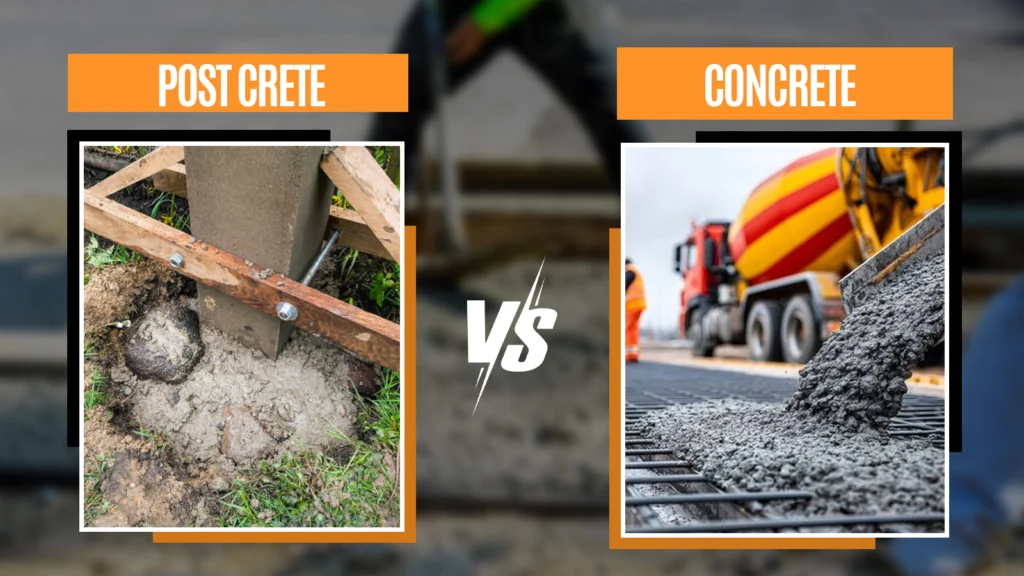
You are standing in a builders’ merchant with a weekend fencing project ahead of you, and the choice comes down to a bag of postcrete or a load of ready mix. Postcrete sets in minutes with no mixing required. That speed is what makes it practical for quick post installations. Concrete takes days to cure, but develops two to four times the compressive strength. That strength is what qualifies it for structural loads that postcrete cannot handle.
Fence posts deal with wind pressure pushing against the panels. That is a manageable lateral load. Driveways and foundations face a completely different challenge because they carry constant vertical weight from above. That gap in demand is what determines whether your project needs a bag from the shelf or a delivery from a batching plant.
What Postcrete Is and How It Works
Postcrete is a pre-blended, rapid-setting mix designed for fixing posts into the ground. It contains cement, aggregates, and chemical accelerators that trigger a faster curing reaction than standard concrete.
What sets it apart is the preparation. You pour the dry powder into the hole around the post, add water on top, and the mix begins hardening within minutes. The manufacturer has already blended the ratio inside the bag, so you skip the mixing stage entirely. That convenience is why postcrete has become a common choice for DIY fence and gate post installations across the UK.
What Is Inside a Bag of Postcrete
- Calcium silicates and calcium aluminates as binding agents
- Fine and coarse aggregate for structure and bulk
- Chemical accelerators that trigger rapid curing
- Trace amounts of lime and alkalis
What Concrete Is and Why It Behaves Differently
Concrete is a mixture of cement, water, and aggregate that undergoes a chemical reaction called hydration to form a dense, load-bearing material. No accelerators push the process along, so curing takes longer. The trade-off is higher strength because the chemical bonds develop more fully over that extended period.
UK concrete is specified under BS 8500, the British Standard that defines strength classes, mix designs, and durability requirements. Grades range from C8/10 for lightweight domestic work up to C50/60 for heavy structural applications. That standardisation is what keeps concrete as the accepted material for foundations, driveways, and any project requiring building regulation compliance.
Standard Mix Ratio for Domestic Projects
The recommended ratio for most domestic work, including fence posts, is:
- 1 part cement
- 2 parts sharp sand
- 4 parts aggregate
- Water is added gradually until the mix reaches a thick, workable consistency
Side-by-Side Comparison
| Feature | Postcrete | Concrete |
| Setting time | 5 to 10 minutes | 24 to 48 hours |
| Full cure | A few hours | 25 to 28 days |
| Compressive strength | 10 to 15 MPa | 20 to 40+ MPa |
| Mixing required | None | Yes, by hand or mixer |
| Best for | Fence posts, washing lines, and small gate posts | Foundations, driveways, slabs, structural work |
| Cost per post | Higher per bag | Lower when bought in bulk |
| Skill level | Beginner-friendly | Requires correct ratios and preparation |
| Structural suitability | Non-structural only | Full structural capability |
When Postcrete Works for You
Postcrete handles one job faster and more conveniently than concrete can. That job is setting posts into the ground without preparation or mixing equipment.
Projects Suited to Postcrete
- Timber fence posts in residential gardens
- Rotary washing line posts
- Small garden gate posts carrying lightweight gates
- Temporary posts or signage that may need replacing
- Any post-installation where speed matters more than maximum load capacity
Why It Handles These Jobs Well
Fence posts deal with lateral force from wind rather than vertical weight from above. Postcrete provides enough resistance for that type of stress. The rapid setting time also means you can install an entire run of posts in a single session rather than bracing each one and waiting 24 hours before moving to the next.
When Concrete Is the Right Answer
Any project involving structural loads, long-term durability, or building regulation compliance needs properly graded concrete. Rapid-setting post mix is not engineered for those demands.
Projects That Need Concrete
- House foundations and footings
- Driveways and parking areas
- Garden slabs and patio bases
- Retaining walls
- Heavy gate posts carrying wrought iron or steel gates
- Any application requiring a structural engineer’s sign-off or building control approval
Why Postcrete Falls Short on These Jobs
Concrete achieves 20 to 40+ MPa of compressive strength depending on the grade. That gives it two to four times the load capacity that postcrete reaches at its peak. The slower curing process also produces a denser material because chemical hydration has more time to bond the aggregates together. That density is what provides resistance to cracking, weathering, and long-term wear under sustained weight.
Postcrete does not carry structural certification and cannot be specified under BS 8500. Ready mix concrete is the material required for any project needing regulatory approval.
How Strength Develops Over Time
The biggest technical difference between these two materials is not just how strong each one gets, but how and when that strength develops after pouring.
| Time After Pouring | Postcrete | Concrete (C25/30) |
| 10 minutes | Firm enough to hold a post | Still liquid |
| 24 hours | 10 to 15 MPa | Beginning to harden |
| 7 days | Near maximum strength | 20 to 25 MPa |
| 28 days | No further gain | 30+ MPa (full rated strength) |
Postcrete reaches its ceiling within hours and stops gaining strength after that point. Concrete continues to develop through ongoing hydration for weeks. That continued development is why a month-old concrete pour ends up substantially stronger than postcrete, regardless of how long postcrete sits in the ground.
What Each One Costs in Practice
The more cost-effective option depends on project size. Postcrete saves money on a single post when you factor in time and convenience. Bulk concrete drops the price considerably when the job involves more than a handful of installations.
| Project | Postcrete | Concrete |
| Single fence post | £3 to £5 per bag (1 bag per post) | £5 to £8 for hand-mixed materials |
| 6 fence posts | £18 to £30 | £15 to £25 for a bulk mix |
| Driveway (10m²) | Not suitable | £80 to £120 per m³ delivered |
| Patio slab base | Not suitable | £80 to £120 per m³ delivered |
How to Use Postcrete Step by Step
The method is straightforward, but getting the basics right determines whether the post stays solid for years or starts loosening within months.
- Dig the post hole to at least 600mm deep, or one-third of the total post length
- Stand the post in the centre and confirm it is plumb using a spirit level
- Pour dry postcrete around the post, filling to within 75mm of ground level
- Add 1 to 2 litres of clean water evenly over the surface
- Hold the post steady and level for 5 to 10 minutes while the mix hardens
- Wait several hours before attaching fence panels or applying lateral force
Mistakes That Cause Posts to Loosen
- Adding too much water dilutes the mix and reduces final strength
- Skipping the spirit level check before the postcrete sets leaves no room for adjustment once it hardens
- Filling to ground level traps rainwater against the post base instead of allowing it to drain away
How to Use Concrete for Posts
Concrete takes more preparation and a longer wait. The result is a stronger and denser footing that performs better under heavier loads and in locations where wind and moisture are constant factors.
- Dig the hole to at least 600mm deep
- Add 50 to 75mm of gravel at the base so water can drain rather than pooling
- Position the post centrally and brace it upright with timber supports
- Mix concrete to a 1:2:4 ratio with water until it reaches a thick, workable consistency
- Pour around the post and tamp it down firmly to push out trapped air
- Slope the concrete surface away from the post, so rainwater runs off rather than sitting against the base
- Leave braces in place for 24 to 48 hours and avoid full loading for at least 7 days
How the UK Weather Affects Each Material
British weather tests freshly poured materials in ways that warmer, drier climates do not. Each product responds to moisture, frost, and temperature shifts differently over its lifetime.
| Condition | Postcrete | Concrete |
| Heavy rain during setting | Risk of washout before it hardens | Slower to set but more resilient once poured |
| Freeze-thaw cycles | More prone to edge cracking over time | Higher density provides better frost resistance |
| Waterlogged soil | Adequate for most garden drainage | Superior long-term moisture resistance |
| High wind loads | Sufficient for standard fence panels | Required for tall fences, heavy gates, or exposed sites |
Where Postcrete Should Not Be Used
Postcrete is not a substitute for concrete in any structural or load-bearing application, regardless of how it is mixed or how much is used.
Applications Where Postcrete Falls Short
- Foundations or footings for any structure
- Driveways, paths, or patio bases
- Retaining walls or garden walls
- Render, grout, mortar, or screed
- Any project requiring BS 8500 compliance or building control approval
Using postcrete for these jobs creates a structural weakness because it lacks the compressive strength and density these applications require. The short-term savings disappear the moment the work needs to be removed and redone with proper concrete.
FAQs
Is postcrete as strong as concrete?
No, postcrete reaches 10 to 15 MPa of compressive strength. Standard concrete achieves 20 to 40+ MPa depending on the grade. Postcrete handles fence posts and garden installations, but does not meet the requirements for structural or load-bearing work.
How many bags of postcrete do I need per post?
One 20kg bag sets one standard fence post in a 600mm deep hole. Larger posts or deeper holes may need two bags.
Can I use Postcrete in the rain?
Light rain is fine because the mix sets before water can wash it away. Heavy rain during the first few minutes can dilute the product before it hardens. Covering the hole or waiting for a dry window is the safer approach.
Final Thoughts
Postcrete and concrete start with the same base ingredient but serve different purposes once they cure. One prioritises speed and convenience for small, non-structural installations. The other delivers the strength, density, and regulatory compliance that load-bearing projects require.
Matching the right material to the right job is the decision that matters. A bag of postcrete handles a garden fence post in minutes. Ready mix concrete handles everything postcrete is not built for. Pro-Mix Concrete has been supplying ready mix across London and the UK for over 20 years. Our volumetric mixers batch the exact quantity you need on site, so you only pay for what gets poured. Whether the job is a set of heavy gate posts or a full foundation pour, our team matches the right grade to your project before the truck arrives.

- Dennis Broderick is the founder and owner of Pro-Mix Concrete Company, a trusted name in ready-mix concrete solutions across the UK. With over 20 years of hands-on experience in the construction and concrete industry, Dennis brings unmatched expertise, practical insights, and a commitment to quality on every project - from residential driveways to large-scale commercial developments.
 BlogMay 21, 2026Postcrete vs. Concrete: Everything You Need To Know
 BlogMay 21, 2026Is It Cheaper To Buy Premixed Concrete
 BlogMay 21, 2026Concrete Slab Expansion Joint Explained
 BlogApril 29, 2026How To Stop Cracking In Concrete Roads In Epsom?